
3 types of Pinched Nerves
When you went to see your Doctor about your pinched nerve, did they tell you about this?
Hello!!
Welcome back!
We want to start off by thanking all our new clients that have joined us. We have seen a huge increase in the number of people that are ready to change their lives and commit to getting better.
We love that they have realized that we are the only place to go for the pain.
Back to this week’s article.
Let me start off by explaining what a nerve is and what it does.
A nerve is what transmits the signals from your brain to your muscles so that when you want to run, your body runs. It also transmits the signals from your body to your brain so that you know what is happening. Like how you know the bathwater is too hot.
The way you must think of nerves is that they work like hose pipes. When there are no problems the signals can flow easily through the nerve like water in a hosepipe.
When the pipe gets pinched or compressed, there is pain and problems like weakness, numbness or pins and needles. The signals cannot reach the areas where they are supposed to go and cannot tell the body what to do.
The nerves start in the brain, travel down the spine in the spinal canal, this part is called the spinal cord, and branch out at every level of the spine. Once they branch out of the spine, they travel down to the area they send signals like your arms or legs. There are only three types. Let me explain them.
Compressed in the spinal canal.
This happens when the spinal cord is being compressed by something as it is going from the brain down to the coccyx.
The two main types of compression are either the hole the cord runs in gets smaller and that compresses the nerve or something in the canal grows and presses on it.
Have a look at this picture to see what I mean.
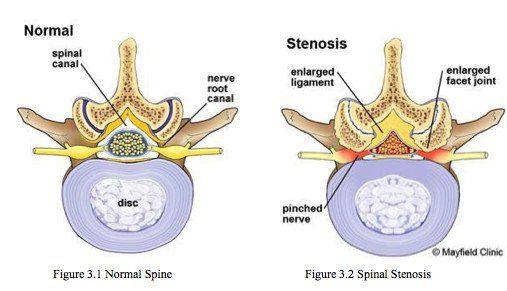
The picture shows what the spine looks like cut in in half across. The yellow wire looking things in the middle is the spinal cord and the disc in behind of it. You can see the one on the left there is a lot of space for the spinal cord but on the right, there Is very little space. It is as if the hosepipe has had wire wrapped around it to make the hole in the middle smaller.
This is more common in older people, over the age of 50. If you think you have this, rather come to us, or see your doctor before you try anything, you really need an expert here.
1. Compressed as it exits the spine.
Remember how I said that the nerves branch off the spinal cord all along the spine? When these branches can also be pinched or compressed as they exit the spine. Think of it as stepping on the hose pipe.
This can happen anywhere along the spine. In the neck, the lower back is the more common places.
The most common thing that compresses the nerve as it exits the spine is a disc that is bulging. Have a look at this picture to see what I mean.
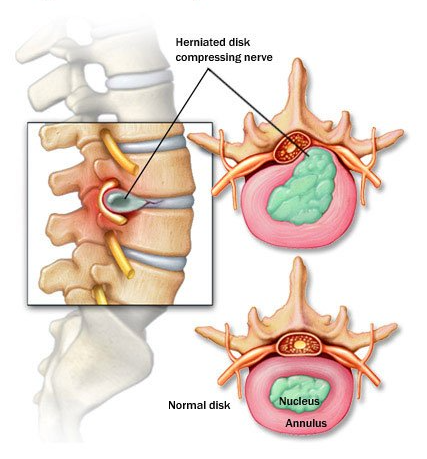
Do you see the one on the bottom looks good? Plenty of space for everything to work well. The one of the top you can see that the nerve, in yellow, is being squashed by the disc because the disc bulged into it.
This can happen to anyone of almost any age. We think that bending and twisting movements while lifting something heavy causes this. Again, this kind of problem you really need an expert to address. It might feel better for a while with rest but then when it comes back you will realize it was not better by just hiding.
1. Compressed along its way down.
The nerve has exited the spine and is on its way down to your hand. As it goes through the different parts of the body, muscles that are in spasm can squash it. Think of that time you wrapped the hosepipe around the trees, and it stopped working. This is what happens here.
The bad news is that is the most common type. Almost everyone with back or neck pain has this too. It also will not go away on its own. The thing that my clients find scary about it is that you will not see it on an x-ray. Your spine might even look perfect, but you are in pain.
It is not having answers for the cause that really scares our clients.
Let us look at a picture.
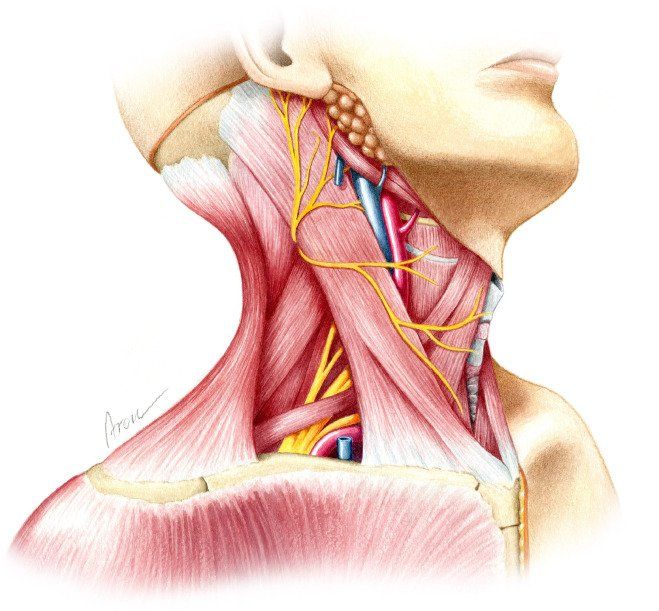
This picture shows the outside part of the neck. The muscles are in red and the nerves in yellow. You can see that one muscle at the bottom is right over the nerves. If that one is in spasm it will squash the nerves right against the neck and you will not see anything on the X-ray.
NOTHING.
That spasm will not go away but instead cause others. So, if you wait to see if you will be better you will end up with 50 problems instead of 2.
The reason pain killers do not work is that there is no injury. The pain is caused by the nerve is being squeezed. That is why it does not seem to get better on pills.
That is why we tell people to stop waiting, it will not get better. If two years have gone by and it’s worse, how will a month be any different?
Are you ready to stop waiting while things get worse?
Jason
